west rutland marsh - june monitoring report

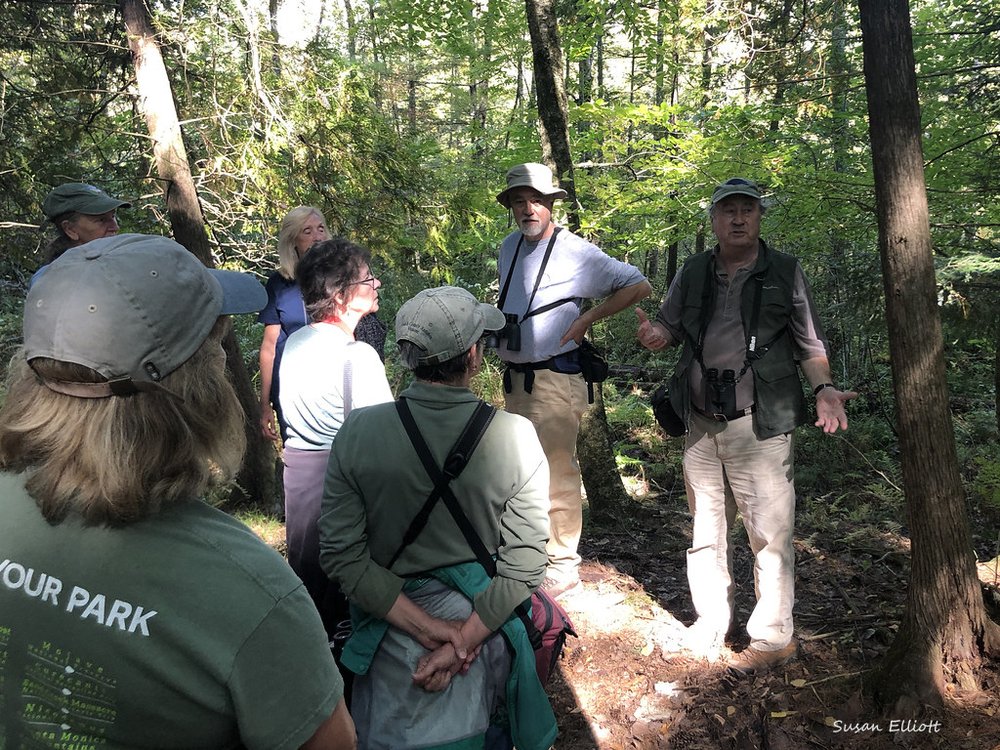
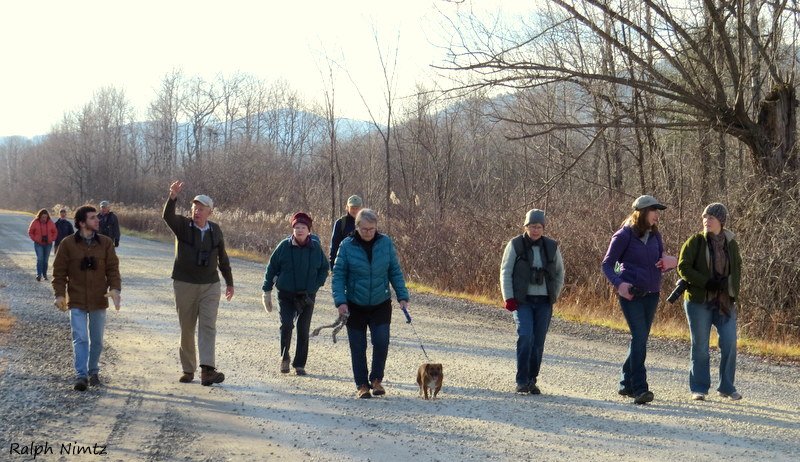
Even on a cool morning in June at West Rutland Marsh, with a few showers, beats just about any other month of the year. Today 13 participants tallied 62 species, one above our June average and four below one year ago.

Gray CatbirdWe joked that today was a bit of a catwalk as we talked to newcomers about the difference between cattails (good) and phragmites (bad), plenty of yakking catbirds, the remains of a dead catfish in the road (which was really probably a sucker) and a non-Audubon approved cat that followed us down the road. Although we take our monitoring seriously we never leave fun out of the equation!

The bird of the day was a flyover Osprey, a species rarely seen at the marsh, and our only raptor of the day.

The expected marsh species were present: a Virginia Rail, two American Bitterns, a flyover Great Blue Heron as well as lots of Marsh Wrens and Swamp Sparrows. A couple sets of sharp ears picked out the low chuckle of a Least Bittern about halfway between the kiosk and the green house. A Green Heron along Pleasant Street was perched on a dead tree, giving its ‘skeow’ call and giving everyone the opportunity for a good look while a second heron flew by.

Green HeronAlong the way we saw an Eastern Kingbird nest, a Baltimore Oriole nest and a Common Grackle nest with young. We know there were plenty more we missed!

The warbler songs were bit muted along Whipple Hollow Road as a light rain started. Nevertheless, Ovenbird, Northern Waterthrush, Black-and-white Warbler, Nashville Warbler, American Redstart, Blackburnian Warbler and Yellow-rumped Warbler were all heard. Plenty of Common Yellowthroats and Yellow Warblers were heard along the marshier parts of the route, along with more redstarts and a Chestnut-sided Warbler.

Thanks to all the new participants who joined us today. If you haven’t participated in a marsh walk we hope to see you soon at one of them!

Today’s list:

Canada Goose  6
Mallard  3   
American Bittern  2
Least Bittern  1   
Great Blue Heron  1
Green Heron  2
Osprey  1
Virginia Rail  1
Wilson's Snipe  4
Rock Pigeon (Feral Pigeon)  1
Mourning Dove  8
Red-bellied Woodpecker  1
Yellow-bellied Sapsucker  2
Downy Woodpecker  2
Northern Flicker  2
Pileated Woodpecker  2
Eastern Wood-Pewee  2
Alder Flycatcher  7
Willow Flycatcher  5
Eastern Phoebe  1
Great Crested Flycatcher  1
Eastern Kingbird  4
Warbling Vireo  6
Red-eyed Vireo  10
Blue Jay  4
American Crow  2
Common Raven  2
Tree Swallow  4
Black-capped Chickadee  7
Tufted Titmouse  1
Brown Creeper  2
House Wren  4
Marsh Wren  11
Veery  7
Wood Thrush  1
American Robin  12
Gray Catbird  8
European Starling  3
Cedar Waxwing  8
Ovenbird  4
Northern Waterthrush  1
Black-and-white Warbler  2
Nashville Warbler  1
Common Yellowthroat  13
American Redstart  6
Blackburnian Warbler  1
Yellow Warbler  11
Chestnut-sided Warbler  1
Yellow-rumped Warbler  1
Chipping Sparrow  1
Savannah Sparrow  1
Song Sparrow  9
Swamp Sparrow  10
Northern Cardinal  5
Rose-breasted Grosbeak  2
Red-winged Blackbird  17
Common Grackle  5
Brown-headed Cowbird  2
Baltimore Oriole  4
House Finch  1
American Goldfinch  8
House Sparrow  3

century count xxi

Bingo! 100 on the nose for today’s RCAS annual Century Count, our annual attempt to tally 100 species in the county. 

Prairie WarblerThis year marked our 21st attempt and, after two years of falling short, it was satisfying to reach our goal. Although grateful for the sunny weather, it felt more like the 4th of July rather than Memorial Day weekend. Bird song seemed to be a bit muted. 

As the group gathered at the West Rutland Price Chopper parking lot a Belted Kingfisher flew over, an unusual site for that location, but a good omen for the day. A brief stop at West Rutland Marsh yielded the usual suspects – Willow and Alder flycatcher, Yellow Warbler and Swamp Sparrow. A Wild Turkey was taking an early morning stroll down the road. 

The Pleasant Street power line is always pleasant in the early morning.  Prairie Warblers, Eastern Towhees and Field Sparrows were heard immediately. “Bees buzz” alerted us to the presence of a winged warbler which turned out to be the real deal, a Blue-winged Warbler, suitably attired for its species. A Prairie Warbler was seen carrying nesting material to an undisclosed location. A Magnolia Warbler was heard in the adjacent woods.

Then it was back to the marsh for the real treat of the morning – the fledgling Northern Saw-whet Owls. Three were spotted in the trees and brush near the nest box. Who would have thought that Least Bittern and Virginia Rail, both also heard, would be eclipsed by owls at the marsh?

Whipple Hollow Road, on the opposite side of the marsh, produced many of the same warbler species observed on last week’s marsh walk: Ovenbird, Northern Waterthrush, Black-and-white Warbler, Nashville Warbler, Northern Parula, Chestnut-sided Warbler and Canada Warbler. 

Next it was on the take on the ticks at the Route 4 rest area. Eastern Wood-Pewee was heard for the first time for the day. Two Wood Thrushes gave a lovely concert despite the traffic noise from Route 4 below. Then finally we found our target – the Cerulean Warbler! At the same area both the Cerulean and a Blackburnian Warbler were singing, reminding us that it is impossible to discern a Cerulean by song alone. Finally, after much neck-breaking searching, we spotted a male Cerulean quite high (of course!) in the trees. It appeared to be hawking insects and, at one point, sat on a branch quivering its wings, leading us to believe a female was nearby.

Along the nature trail at Castleton University we picked up Pine Warbler and Louisiana Waterthrush. While sitting in traffic waiting for the marching bands from the Castleton parade to clear, we added Chimney Swift and Carolina Wren.

Our lunch stop at Bomoseen State Park was a welcome respite from the heat. While there we heard Yellow-throated Vireo and Blue-gray Gnatcatcher. An American Redstart was building nest and a Scarlet Tanager was spotted.

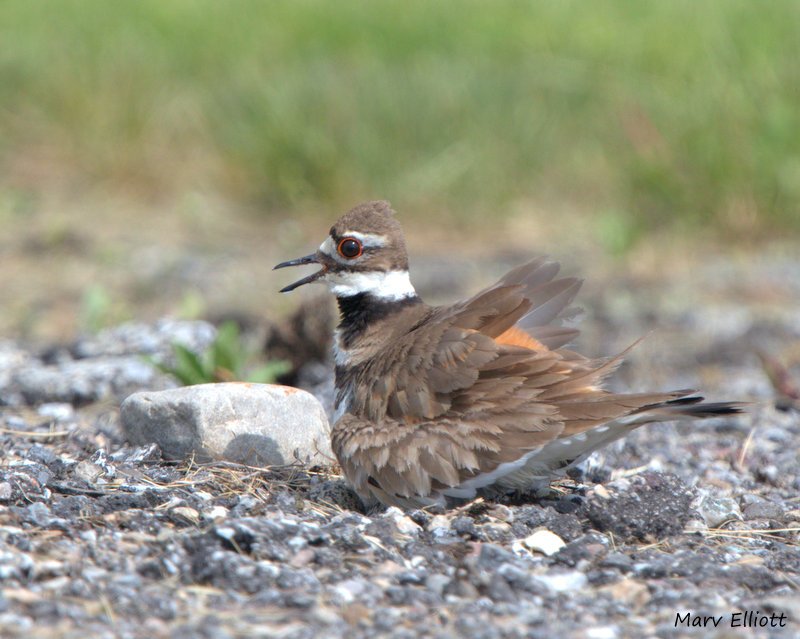
KilldeerBobolinks were found at the Fair Haven Airport and two very hot Killdeer were sitting tight on their nests to keep their eggs cool. 

It is becoming difficult to see anything on the conserved land along Route 73 in Brandon/Sudbury as the willows and other vegetation has grown up. However, six Great Blue Herons were seen in flight, along with two Wood Duck. There was a lot of rattling of Marsh Wrens. A Common Gallinule was also heard.

The day ended with a stop at Wildcat Road and Lefferts Pond in Chittenden, where we picked up Winter Wren, Brown Creeper, Black-throated Blue Warbler and Yellow-rumped Warbler. A Broad-winged Hawk was seen perched in the dark woods. And the final bird of the day: a Common Loon floating serenely on Chittenden Reservoir. 

Every Century Count has a species that is inexplicably missed. This year there were three: Hermit Thrush, Black-throated Green Warbler and House Finch (a Purple Finch/House Finch was seen, but its true identity was never determined).

Once again, thanks to Roy Pilcher, for planning the trip and the 12 participants who used their sharp eyes and ears to good advantage.

The day's list (27 eBird checklists were entered for the day):


Canada Goose
Wood Duck
Mallard
Wild Turkey
Common Loon
American Bittern
Least Bittern
Great Blue Heron
Turkey Vulture
Northern Harrier
Broad-winged Hawk
Red-tailed Hawk
Virginia Rail
Common Gallinule
Killdeer
Rock Pigeon
Mourning Dove
Northern Saw-whet Owl
Chimney Swift
Ruby-throated Hummingbird
Belted Kingfisher
Red-bellied Woodpecker
Yellow-bellied Sapsucker
Downy Woodpecker
Hairy Woodpecker
Northern Flicker
Pileated Woodpecker
American Kestrel
Eastern Wood-Pewee
Alder Flycatcher
Willow Flycatcher
Least Flycatcher
Eastern Phoebe
Great Crested Flycatcher
Eastern Kingbird
Yellow-throated Vireo
Warbling Vireo
Red-eyed Vireo
Blue Jay
American Crow
Common Raven
Northern Rough-winged Swallow
Tree Swallow
Barn Swallow
Cliff Swallow
Black-capped Chickadee
Tufted Titmouse
Red-breasted Nuthatch
White-breasted Nuthatch
Brown Creeper
House Wren
Winter Wren
Marsh Wren
Carolina Wren
Blue-gray Gnatcatcher
Veery
Wood Thrush
American Robin
Gray Catbird
European Starling
Cedar Waxwing
Ovenbird
Louisiana Waterthrush
Northern Waterthrush
Blue-winged Warbler
Black-and-white Warbler
Nashville Warbler
Common Yellowthroat
American Redstart
Cerulean Warbler
Northern Parula
Magnolia Warbler
Blackburnian Warbler
Yellow Warbler
Chestnut-sided Warbler
Black-throated Blue Warbler
Pine Warbler
Yellow-rumped Warbler
Prairie Warbler
Canada Warbler
Chipping Sparrow
Field Sparrow
Dark-eyed Junco
White-throated Sparrow
Savannah Sparrow
Song Sparrow
Swamp Sparrow
Eastern Towhee
Scarlet Tanager
Northern Cardinal
Rose-breasted Grosbeak
Indigo Bunting
Bobolink
Red-winged Blackbird
Eastern Meadowlark
Common Grackle
Brown-headed Cowbird
Baltimore Oriole
American Goldfinch
House Sparrow


west rutland marsh - may monitoring report

Nothing beats May at the marsh! This beautiful morning 26 participants tallied 74 species, not quite close to last May’s 81, but well above this month’s average of 68.

A Least Bittern was heard along Marble Street, just north of the kiosk, giving its low chuckle. One American Bittern was heard and one was seen. Two Green Herons were observed at the mid-point of the walk along Pleasant Street. Five Great Blue Herons were flying high in formation, perhaps towards the heronry in Florence.

Two Virginia Rails were seen well near the boardwalk engaged in, well, making more rails. A third rail was heard along Water Street. Wilson’s Snipe have been in much evidence this year – one was heard from the boardwalk and there were two more near the power line.

Virginia RailThe full flycatcher contingent is in: Alder, Willow, Least, Great-crested Flycatcher were all present as well as Eastern Phoebe and Eastern Kingbird, all very vocal.

A Red-breasted Nuthatch, a species not often seen at the marsh, was observed near a possible nest hole. Interestingly no White-breasted Nuthatches were seen. 

All three of the expected thrushes were singing – Veery, Hermit and Wood. A fourth thrush, an American Robin, was seen carrying food. Red-winged Blackbirds and Grackles were also carrying food so the season is well underway. 

Along with Yellow Warblers and Common Yellowthroats along the whole route, there was a nice assortment of warblers along Whipple Hollow Road. Three Canada Warblers and a Northern Waterthrush were in their usual spots. Also present were Ovenbird, Black-and-white, Nashville, American Redstart, Northern Parula, Blackburnian, Chestnut-sided, Yellow-rumped and Black-throated Green.

One Savannah Sparrow was singing along Marble Street.

The next marsh walk is scheduled for Saturday, June 11, at 7 a.m.

The day's list:

Canada Goose 14
Wood Duck 1
Mallard 3
Wild Turkey 1
American Bittern 2
Least Bittern 1
Great Blue Heron 5
Green Heron 2
Turkey Vulture 1
Virginia Rail 3
Wilson's Snipe 3
Mourning Dove 18
Belted Kingfisher 1
Yellow-bellied Sapsucker 2
Downy Woodpecker 5
Hairy Woodpecker 2
Northern Flicker 1
Pileated Woodpecker 2
Alder Flycatcher 3
Willow Flycatcher 2
Least Flycatcher 6
Eastern Phoebe 4
Great Crested Flycatcher 2
Eastern Kingbird 4
Yellow-throated Vireo 1

Warbling Vireo 9
Red-eyed Vireo 7
Blue Jay 13
American Crow 3
Common Raven 4
Northern Rough-winged Swallow 2
Tree Swallow 5
Barn Swallow 6
Black-capped Chickadee 13
Tufted Titmouse 4
Red-breasted Nuthatch 1
House Wren 3
Marsh Wren 11
Veery 7
Hermit Thrush 1
Wood Thrush 1
American Robin 8
Gray Catbird 18
European Starling 2
Cedar Waxwing 4
Ovenbird 7
Northern Waterthrush 1
Black-and-white Warbler 4
Nashville Warbler 1
Common Yellowthroat 30
American Redstart 14
Northern Parula 2
Blackburnian Warbler 1
Yellow Warbler 19
Chestnut-sided Warbler 3
Yellow-rumped Warbler 1
Black-throated Green Warbler 2
Canada Warbler 3
Chipping Sparrow 2
Savannah Sparrow 1
Song Sparrow 12
Swamp Sparrow 17
Eastern Towhee 1
Scarlet Tanager 2
Northern Cardinal 6
Rose-breasted Grosbeak 1
Red-winged Blackbird 34
Common Grackle 8
Brown-headed Cowbird 1
Baltimore Oriole 4
House Finch 2
Purple Finch 3
American Goldfinch 26
House Sparrow 1

flight of the snowbird

Ring-billed GullMention the term "snowbird" and what comes to mind? If you are a birder you are hoping for an influx of birds from Canada to our area. However if you are of a certain age you think of leaving the cold for warmer climes. My story involves both of these migrants.

In late December we headed south to Titusville, Florida which is on the east coast right across from the Kennedy Space Center. Just minutes away is the Merritt Island National Wildlife Refuge. This refuge offers a wide variety of winter migrants as well as endemics. A tour through the Black Point Drive is always filled with great flocks of waders, coots, ducks and other species that can be observed fairly close up.

Playalinda Beach is a short ride from this drive and offers a chance of seeing Northern Gannets as well as shorebirds such as Ruddy Turnstones and the ever cute Sanderlings. As I made my way down this beautiful beach I came upon a small group of Royal Terns and Laughing and Ring-billed gulls.

Close inspection of the group revealed that one of the Ring-billed Gulls was banded, both with the standard aluminum band plus a blue tag on the other leg. I quickly got out my camera and took some photos of the gull. Upon returning to our campground I reviewed the photos and found that the band had the alpha-numeric code of 3AF. Thanks to technology I went online and googled "ring-billed gulls with bands." The site came up immediately and I filled out the form with all the details of where and when as well as the identification tag. The next morning my email had been answered. Professor Jean-Francois Giroux, a professor at the University of Quebec in Montreal, is part of a study of these gulls and how they disperse.

My bird, I was told, is a male, banded on May 17, 2012 on Ile Delauriers, Varennes, Quebec. Subsequently it has traveled from there to Playalinda Beach and has been seen most winters. Come late March this snowbird makes his way back to Canada.

A couple of years ago I had seen a Ring-billed Gull on the very same stretch of beach with the same tag! The odds of seeing a tagged bird more than once is rather remote, but here was my bird loafing in the sunshine once again!

Finding birds with this type of banding and reporting the information to the proper study groups gives the researchers valuable data. So be on the lookout for any tagged birds, get a photo or write down the tag information. This is just another venue for the citizen scientist to add to the knowledge of migratory birds.


annual meeting and elections announcement

Rutland County Audubon Society will hold its annual meeting on Wednesday, July 6, 2016 at the Proctor Library, 6 PM. The primary purpose of the meeting is the election of officers and directors for the following year. Nominations are now open. If you are interested or know someone who would be a good candidate please contact Marv Elliott at birding@rutlandcountyaudubon.org. Nominations will be taken from the floor.

The evening will include a potluck supper. Bring a dish to share. Utensils, beverages and a dessert will be provided.


rusty blackbird migration blitz results

The following is by Bruce MacPherson, Green Mountain Audubon Society:

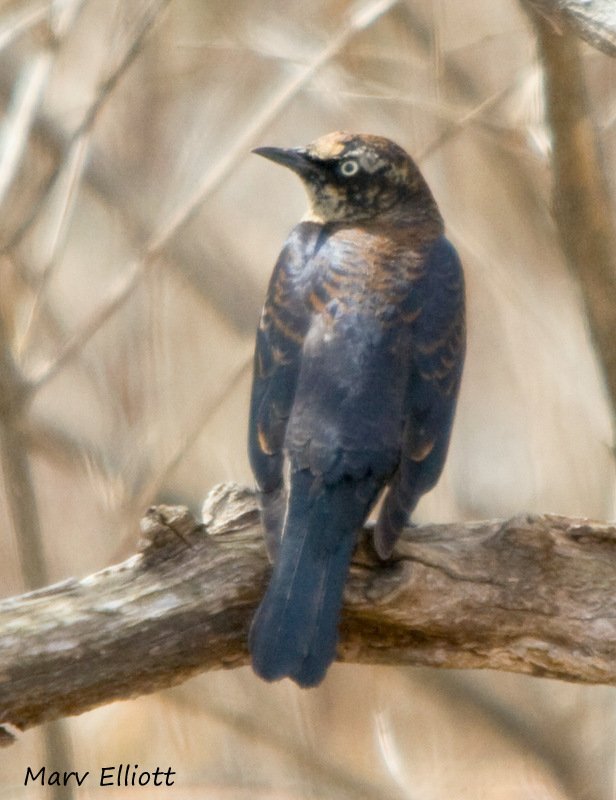
Rusty Blackbird populations have plummeted by over 85% in the past half century and no one knows why. Recognition of the catastrophic decline of this once-common bird eluded birders and conservation biologists until the past decade. Now a group of international investigators led by the International Rusty Blackbird Working Group is studying this problem by collecting data during the Rusty Blackbird's spring migration.

The count period for the Rusty Blackbird Spring Migration Blitz in Vermont ended on Saturday, April 30. Thanks to everyone who participated in this citizen-science project.

Rusties finally moved through Vermont in good numbers during the last week of the count. Overall 761 Rusty Blackbirds were reported to VT eBird during our count period of March 15-April 30 compared to 658 in 2015 and 1090 in 2014. In the five years prior to the Blitz (2009-2013) the average number of Rusties reported during the count period was 187. The increased numbers in 2014-2016 are almost certainly the result of the increased effort by Vermont birders to find and report Rusty Blackbirds. Click here to see an eBird map of Vermont's sightings.

Rusty Blackbirds breed in marshes and bogs in the boreal forests of Canada and the northern United States, including Vermont's Northeast Kingdom. Vermont is at the southeastern edge of the Rusty Blackbird's breeding grounds. During the Second Vermont Breeding Bird Survey nesting sites for this frequently overlooked bird declined in the western part of Vermont, but increased in the northeastern highlands, possibly due to increased effort directed toward finding their nests. Nonetheless, only 20 nests were recorded in the second atlas down from 26 in the first survey. In 2014, at the urging of several conservation groups Rusty Blackbirds were added to the list of Vermont's endangered species. Understanding the factors affecting Rusty Blackbirds on their breeding grounds, wintering habitat, and migration stopovers will be essential first steps toward stabilizing the population.

Congratulations to Jim Osborn, who reported 184 Rusty Blackbirds along the Maquam Bog/ Old Railroad Passage Trail at the Missisquoi NWR on April 23, the highest count in Vermont this year. This observation along with those of several other observers establishes the refuge as the main stopover point for Rusties in migration in Vermont. 

But as Yogi reminds us "It's not over until it’s over." Last year only 67% of the Rusties in Vermont during migration were counted between March 15 and April 30. A significant number of Rusty Blackbirds will likely migrate through Vermont during the next two weeks. To get a full picture of the scope of Rusty migration Vermont birders are encouraged to visit Rusty Blackbird habitat during May and report their counts to VT eBird.

Interestingly, Rusty Blackbird breeding in the northeast has already begun. An occupied nest was found in New Hampshire on April 29 and Rusties have shown up at Moose Bog, a Vermont breeding site, during the past week.

So let's get out there and count those birds. Every Rusty Blackbird counts!


a sliver of redwood

This sliver of redwood is so small and weathered that an expendable matchstick would hold it with little esteem. It came from a redwood corpse now prostrate and long silent. For how long this redwood giant had rested there, only its living relatives know. Time is measured by them, neither in days nor years nor even decades, but centuries. This hulk of a giant with the girth and length of a commuter train was fortunate to die full of years, yielding his place to the next generation in crashing headlong into the embrace of mother earth. Along with his immediate living family gathered about him, they constitute the fortunate ones. With nineteen out of twenty of their kith and kin felled first by the axe and then by the chainsaw, this generation of giants that survives on these California foothills does so under special dispensation and protection.

It was an idyllic life, the happy confluence of soil and solitude, moisture and moderation, altitude and latitude that combined together to produce a sustained but measured growth. With head reaching to the heavens above and roots buried deep in the rich earth below it was, or so it appeared to be, a benevolent universe and without bounds. Daily mists sailed inland borne on winds traversing the cold California Current ever willing to cool and quench any lingering thirst that he or another maturing giant may generate. With crowns jostling for space and with bodies lean of limb, if branches should find room to extend horizontally, there a universe of lichens and mosses and an array of air breathing plants abounded. There the Marbled Murrelet, an avian creature of the oceans, would lay its single egg. There a lone chick would anxiously await the fading light of dusk for a parent’s return with sustenance from the sea.

If danger there was, it was heaven sent! Dark and foreboding cumulus clouds drawn eastward from the rising thermals of the Great Basin patiently waited an opportunity to discharge their burden of electrical energy. The giant who stood the tallest and stoutest would serve as nature’s lightning rod and would be humbled. The path traveled by the surge of electrical energy would instantly render sap to steam and in the process split the protecting bark asunder. From thence it would be a slow death, a half a century may be, but this majestic giant could not and would not survive heaven’s chastisement. In the event of a conflagration that death would be hastened while others, with their thick and fire resistant bark still intact, had less to fear. However, there would be casualties.  

All the while in the cool and moist dappled world below, a profusion of ferns and shrubs vied for whatever sunlight penetrated the canopy above, all pygmies at peace amidst the kingdom of giants.  

From a lowly California dogwood, a Varied Thrush called.  Evening came and morning came, and God acknowledged that what he saw was good.

California, summer 2001


west rutland marsh - april monitoring report

American BitternA stiff north wind dispelled any notion that spring is here to stay. Nevertheless a record 31 participants showed up for the 177th monitoring walk around West Rutland Marsh. Forty-four species were tallied, more than last year's 37 and two above our April average.

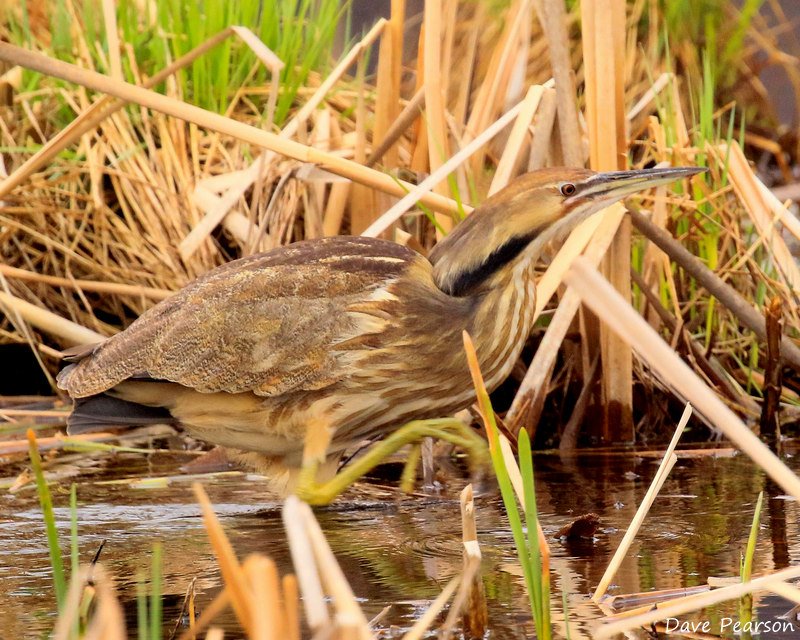
The day was off to a good start when the ‘kidick kidick’ of a Virginia Rail was heard near the boardwalk. Shortly after that sharp eyes spotted an American Bittern lurking along the not yet emerged reeds. Even then it was hard to spot! Wilson’s Snipe was also heard ‘woo woo woo-ing’ and a lucky few spotted it.

If there is any doubt that nesting season is already underway, six goslings were spotted with a Canada Goose. A Blue Jay was seen carrying nesting material and its fellow corvid, a Common Raven, was carrying a sizeable bit of food. Two Belted Kingfishers were spotted near a likely nest hole above one of the quarries.

Raptors were well-represented: Northern Harrier, Red-tailed Hawk, Broad-winged Hawk, Peregrine Falcon and American Kestrel. Ten Turkey Vultures were also seen.

No Tree Swallows were seen, but three cold-looking Northern Rough-winged Swallows were huddled in a bare tree.

A Winter Wren was heard deep in the woods along Whipple Hollow Road and Marsh Wrens (2) were heard along Water Street and near the boardwalk.

A lingering American Tree Sparrow was spotted near the feeders at the kiosk. Swamp Sparrows have wasted no time and are singing throughout the marsh.

The next marsh walk is scheduled for Thursday, May 19, 7 a.m.

Today's list:

Canada Goose  29
Wood Duck  1
Mallard  7
Hooded Merganser  2
American Bittern  2
Great Blue Heron  1
Turkey Vulture  10
Northern Harrier  1
Red-tailed Hawk  2
Virginia Rail  1
Wilson's Snipe  3
Rock Pigeon (Feral Pigeon)  2
Mourning Dove  10
Belted Kingfisher  2
Red-bellied Woodpecker  1
Yellow-bellied Sapsucker  2
Downy Woodpecker  2
Northern Flicker  6
American Kestrel  1
Peregrine Falcon  1
Eastern Phoebe  3
Blue Jay  3
American Crow  4
Common Raven  2
Northern Rough-winged Swallow  3
Black-capped Chickadee  12
Tufted Titmouse  3
Winter Wren  1
Marsh Wren  2
Ruby-crowned Kinglet  4
American Robin  9
European Starling  3
Cedar Waxwing  2
American Tree Sparrow  1    near feeders at kiosk; present consisently all winter
Dark-eyed Junco (Slate-colored)  4
White-throated Sparrow  3
Song Sparrow  14
Swamp Sparrow  16
Northern Cardinal  5
Red-winged Blackbird  26
Common Grackle  8
House Finch  2
American Goldfinch  24
House Sparrow  3


thank you judy hawley!

We’ll never know the fate of the wayward painted bunting in Pittsfield that thrilled birders last month, but the story does have a happy ending.

Judy Hawley, whose property the bunting frequented, thanks to her generous supply of seed, thought the bird might be unusual. (We have some nice birds in Vermont, but nothing quite that colorful.) Fortunately she found eBird and reported the sighting. The rest, as they say, is history. During the next five days, scores of birders visited and dozens of photos were snapped. Bird chatter on the vtbird listserv and Facebook was at a high pitch. Reports of the sighting even reached national media outlets.

Through it all Judy gracefully welcomed birders to her property.

Birders as a whole are a generous and responsive group. As a thank you for Judy’s hospitality, birders throughout Vermont and outside the state contributed money to buy her a gift card for seed. It was delivered to her on Friday. We know she will put it to good use.

As Judy put it, "The beautiful little bunting not only brought himself for me to enjoy, but so many wonderful people I otherwise would have never met."

Also from Judy: "A very warm thank you for the extremely generous gift card, along with all the pictures you sent of the bunting and notes of appreciation. Your thoughtfulness has touched me more than I can say."

the patience of job

The window of opportunity was still open as Roy walked the Pittsford Trails that steamy July afternoon in his priority block, Proctor 4. This was the third year of the second five-year Vermont Breeding Bird Atlas project. A couple more weeks and the breeding season would be as good as over for the year. 

The sound of the brook was soothing on this unduly hot day. Roy had heard many a male Ovenbird singing in suitable habitat, but breeding confirmation had eluded him. As Roy followed the bend in the path from above and to his left there broke forth an agitated series of chatterings, as if two pebbles were being tapped in rapid succession. Roy would take his time for this was surely an opportunity to score one more breeding confirmation. The clicking persisted but it was difficult to zero in from whence it came. Finally Roy caught a glimpse of one of the perpetrators striding along a horizontal branch, calling as it went. The minutes went by and the mosquitoes had their fill but Roy remained riveted, ears and eyes straining. Eventually the agitation subsided until there was but a single bird registering its concern. It would not be long. Roy was sure there would be some telltale exposition of a nest or the call of a demanding fledgling. 

All of a sudden Roy’s world was compromised as a large black lab straining at the leash with his mistress in tow noisily erupted upon the scene from behind him. Roy was sure all was lost. A single bird raised the alarm but as the intruders’ presence faded into the distance and the commotion subsided, a second bird emboldened by the intruders’ departure dropped to a lower branch straight ahead of Roy. Oblivious to Roy’s presence the Ovenbird strode boldly forward, a juicy caterpillar in its beak, a meal for some hidden nestling or fledgling! Breeding confirmed!

 “Thank you, thank you,” Roy muttered in appreciation and relief as he checked off: Ovenbird, Carrying Food (CF), 07/19, Breeding Confirmed!

west rutland marsh - march monitoring report

Spring started Sunday and winter returned Thursday. Some of us woke to a bit of snow on the ground and a biting breeze. Despite this RCAS tallied 31 species on its 176th walk around West Rutland Marsh. This beats last year’s 21 and the average monthly total for March of 23.

Red-winged Blackbirds are staking out their territories as are the Common Grackles. Mallards (and one Wood Duck) were seen flying over the cattails. A Belted Kingfisher was also spotted.

American Tree Sparrows are still hanging around the feeders at the boardwalk. Song Sparrows have returned in good numbers with 14 spotted (and many heard singing).

Two Carolina Wrens were heard. Bird song everywhere is ramping up despite the cool temperatures.

One highlight of the walk was a Northern Shrike perched high on a tree. It has been spotted on and off (mostly off!) at this location during this past winter.

Another highlight of the day was a male Northern Bluebird.

A Northern Flicker was heard across from the boardwalk and two Turkey Vultures were feasting on something along Marble Street on our return.

Our next marsh walk is scheduled for Saturday, April 23, for (please note!) 7 a.m.

Today's list:

Canada Goose  111   
Wood Duck  1
Mallard  14
Wild Turkey  36
Turkey Vulture  2
Red-tailed Hawk  1
Mourning Dove  17
Belted Kingfisher  1
Downy Woodpecker  4
Northern Flicker  1
Pileated Woodpecker  1
Northern Shrike  1
Blue Jay  5
American Crow  7
Common Raven  1
Black-capped Chickadee  19
Tufted Titmouse  2
White-breasted Nuthatch  1
Carolina Wren  2
Eastern Bluebird  1
American Robin  14
European Starling  7
American Tree Sparrow  7
Dark-eyed Junco (Slate-colored)  22
Song Sparrow  14
Northern Cardinal  7
Red-winged Blackbird  23
Common Grackle  11
House Finch  3
American Goldfinch  38
House Sparrow  3
 

taking action

Golden-winged Warbler, a species of concernA visit to the voting booth is not the only way we can make our wishes known to our elected representatives. Following the legislative process, here in Vermont and nationally, is important too, but it can be bewildering and sometimes frustrating.

How can we know what’s coming up and the ramifications of proposed bills when it comes to environmental issues? Audubon’s Activist Alerts are the answer. By signing up you’ll receive emails on important issues, proposed legislation and upcoming votes. The alerts are tailored to where you live matching you to your national and state lawmakers. The alerts contain simple steps to have you take action. Click here to sign up.

mid-winter eagle survey results

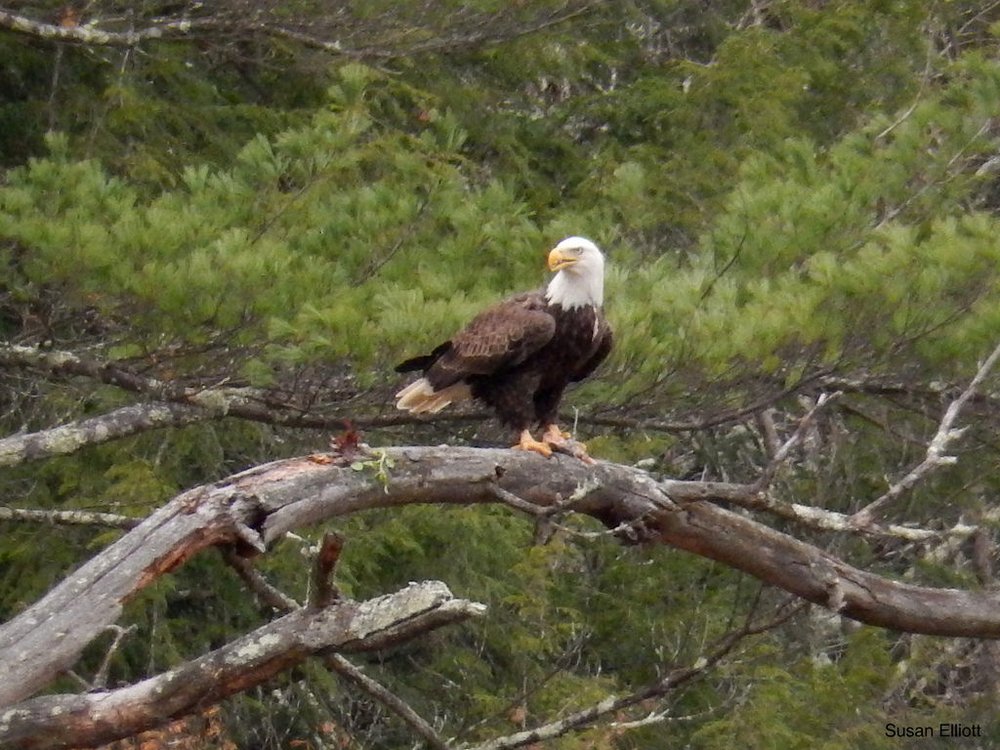
Bald Eagle on the Cadwell Loop on an earlier dateIt wasn’t too long ago that spotting a bald eagle in Vermont was a rare occurrence. Happily, that has changed and seeing one, while always exciting, is no longer that unusual.

This January’s Winter Bald Eagle Survey confirms the trend. According to Margaret Fowle, of Audubon Vermont and coordinator of the survey in the state, 59 eagles were observed on standard routes and other areas. Although this number is down from the prior year’s 81, the number of adults observed was a new record. Overall bald eagles numbers for the survey from its start in Vermont in 1979, when no eagles were observed, have showed a steady increase.

Although a greater number of eagles were found further north in Addison and Chittenden counties along Lake Champlain, Rutland County had its share. RCAS members Mike Blust and Nate Dansereau, surveyed Lake Bomoseen, Lake St. Catherine and Lake Hortonia, coming up with two, one and one respectively. Hortonia’s was a first for the survey.

So keep your eyes open especially now that the ice is going out! And be sure to eBird your sightings!

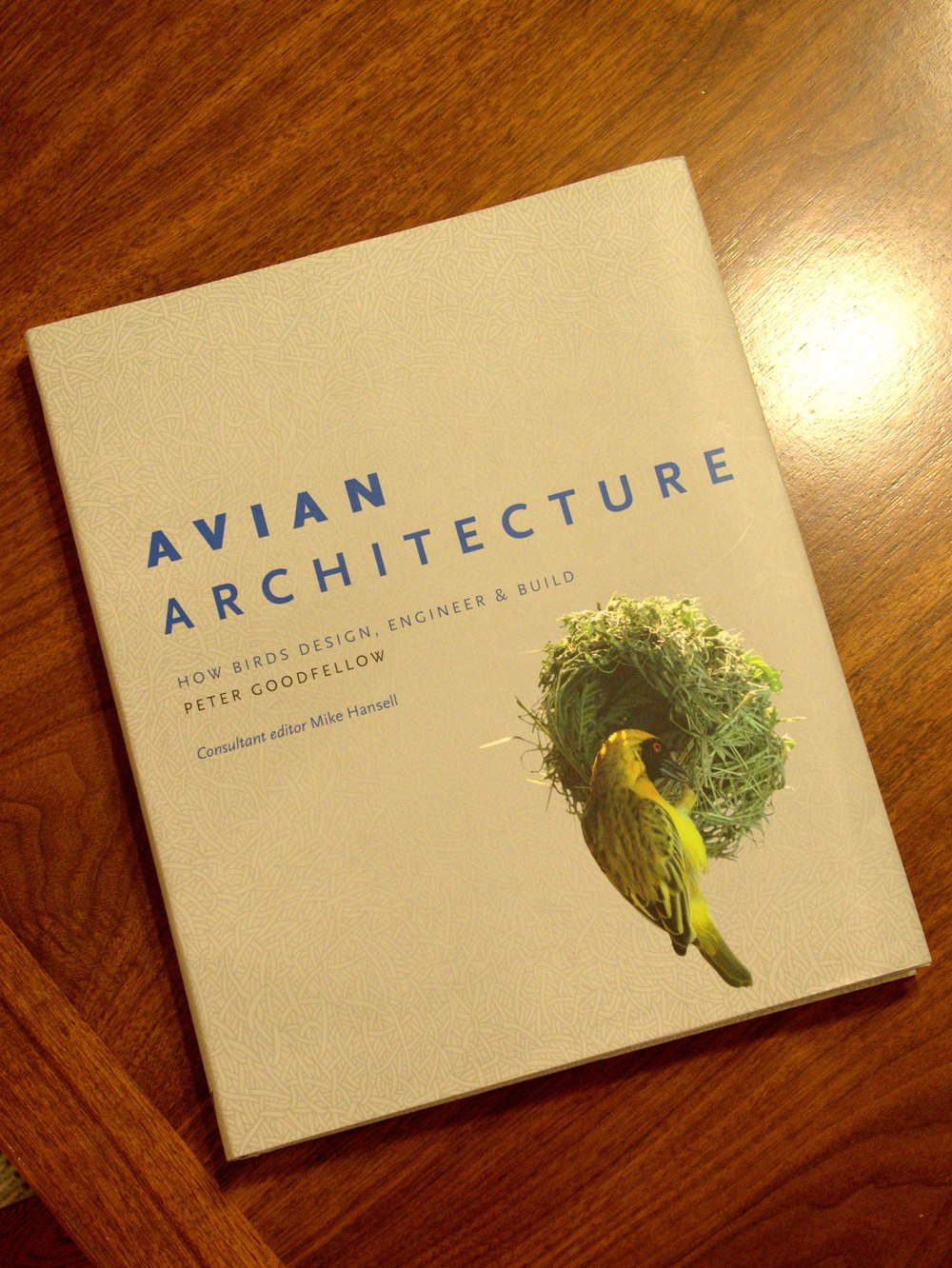
book review: avian architecture by peter goodfellow

Master human architects skillfully design dwellings that optimally meet their clients’ needs and fit in well with their surroundings, both functionally and aesthetically. Equally so are the goals of birds as they construct their nests. Indeed, given the importance of the nest for successful reproduction and nurturing of the young, one wonders why other mammals have not cultivated this ability, through natural selection, to as high a degree as birds. Peter Goodfellow in Avian Architecture ponders these questions and further delves into the entire realm of avian engineering, from overall design plans to intricate construction techniques.

The book is well organized. Each chapter begins with an overview of a specific type of nest with key structural characteristics and building methods, and prominent representative families. Next, the architectural characteristics of each nest type are delineated as ‘blueprint drawings,’ crisp blue and gray drawings highlighting the component materials and their interrelationships in design, shape, structural support and strength. With photographs, in the ‘materials and features’ section, Goodfellow continues on to discuss unique aspects such as camouflage, distinctive adaptations to habitat and incorporation of available material. The 'building techniques’ pages expound upon remarkable skills such as the stitching and weaving of some passerines. ‘Case studies’ conclude each section; he discusses an individual species’ nest type in depth, including notes on courtship and mating, monitoring of eggs and care of young.

The author outlines eleven nest categories: scrape nests; holes and tunnels; platform nests; aquatic nests; cup-shaped nests; domed nests; mud nests; hanging, woven and stitched nests; mound nests; colonies and group nests; and courts and bowers. To the uninitiated, this may seem detailed, but Goodfellow’s presentation of each type is so lucidly well-composed, explained and diagramed that the read feels assured of a comprehensive understanding of each discrete nest type. Also, the author brings in examples of birds from around the globe, greatly expanding beyond the nest types we commonly encounter.

I will mention a few I found especially fascinating. The female Great Hornbill (a huge bird of India and the Far East) nests in the cavity of a dead tree and, once settled in, the female seals up the opening with mud to a narrow slip and there remains for months, completely dependent on the male for food. The Magpie Goose, a waterfowl, builds a reed platform nest by clutching reeds in her beak and folding them down about her, forming a base like the spokes of a wheel.

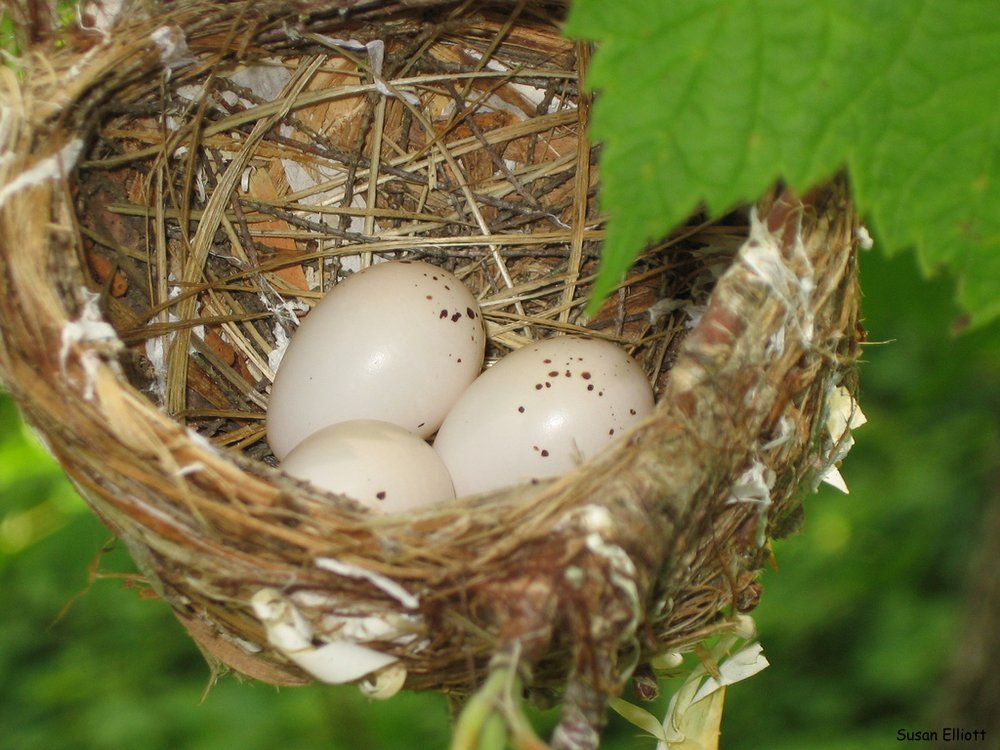
Red-eyed Vireo nestAs you continue through the book, you quickly discover that nests are not mere piles of debris, sticks, grasses, etc. Rather, just as most of us have learned that baskets are made by twining and binding strands around upright spokes, likewise birds carefully integrate weaving material about vertical supports. Aquatic nest builders depend upon standing reeds, rushes and sedges for structural bracing. Cup-shaped nest-builders often use the triple fork of a branch as a foundation. Woven nests (ex. Oriole) do not by happenstance have a plaited surface appearance. Rather, Goodfellow illustrates the intricate weaving methods, as the bird, with her beak, pushes a grass strip through, tucks in the short end, threads the long and through nearby fibers, pulls it out and around and makes loops, through which it pulls strands to create a secure binding. A Baltimore oriole nest comprises 20,000 such shuttle movements and takes four and one-half days to build.

Most of us are familiar with nests of twigs, grass, reeds, lichen, moss, and mud. Some mound builders, such as the Adele Penguin, use stones. Horned Coots (South America) pile up stones offshore to build a safe artificial island nest.

Some species build nests in groups or colonies. The tightly packed nests of swift colonies are a familiar example. But the Sociable Weaver constructs one large nest with multiple inlets like a gigantic apartment block.

The Bowerbird’s engineering efforts aim at ‘statement architecture designed solely to attract females.’ The construction activity itself is a type of courtship behavior. The attracted female, after mating, flies off to build a commonplace nest. The three types of bowers, stage, avenue and maypole, attest to their display purposes, and in the case of the Satin Bowerbird, go to the extreme of decorating the entryway with distinctly blue feathers and stones.

Although nest building has long been considered innate and instinctive, learning may also play a role. The Vogelkop Bowerbird male spends four to seven years practicing bower making before he breeds.

This is an engrossing book. The numerous types of bird nests are explicitly described by the succinct ‘blueprint’ illustrations, followed by step-by-step diagrams of construction techniques, case examples with photos, and further discussion of nest habitat and mating and incubation behavior.

I purchased the book from E. R. Hamilton, Bookseller Co., PO Box 15, Falls Village, Ct 06031-0015, on sale for $9.95. You could also try Amazon, or better yet, a local store like Bookmobile or Phoenix Books (for special order). 

Click here is a list of other RCAS book reviews: 

west rutland marsh - february monitoring report

Four hardy souls braved today’s frigid temperature and wind for this morning’s 175th consecutive monthly monitoring walk around West Rutland Marsh. Despite the weather, 18 species were tallied. This compares to 20 species a year ago.

None of the species were unexpected, but a small flock of Cedar Waxwings looked beautiful in flight in the morning light. Two Common Ravens were vocalizing and fussing near their usual nest site in the quarries.

A single American Robin was eating berries while chickadees were taking advantage of the various feeders along the route. American Tree Sparrows were also much in evidence at the feeders.

At the halfway point, with the wind at our backs and in full sun, the walk turned into a very pleasant experience.

Today’s list:

Mourning Dove  8
Downy Woodpecker  1
Hairy Woodpecker  1
Blue Jay  14
American Crow  8
Common Raven  2
Black-capped Chickadee  34
Tufted Titmouse  2
White-breasted Nuthatch  2
Carolina Wren  1
American Robin  1
European Starling  9
Cedar Waxwing  12
American Tree Sparrow  13
Dark-eyed Junco (Slate-colored)  13
Northern Cardinal  6
American Goldfinch  10
House Sparrow  4

great backyard bird count: february 12-15

White-breasted NuthatchThis weekend, February 12 through 15th is a great opportunity to find out what citizen science is all about. The 19th annual worldwide Great Backyard Bird Count starts this Friday. You can participate in any or all of the four days for as little as 15 minutes. It is open to birders (everyone is a birder - some don't know it yet) of all skill levels.

The GBBC is a project of the Cornell Lab of Ornithology, National Audubon and Bird Studies Canada. This year's odd weather patterns may produce some interesting results!

Click here for downloadable instructions. Need help, click here for online bird guides.

christmas bird count results

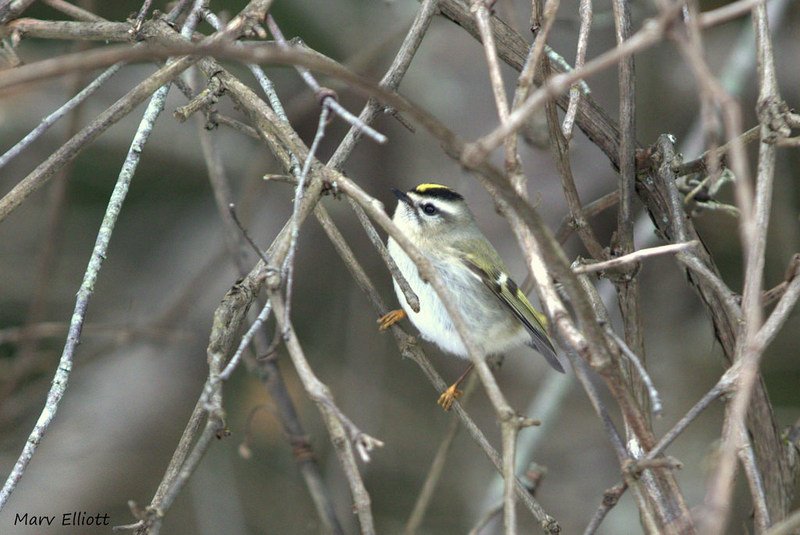
Golden-crowned KingletRutland County Audubon’s 42nd Annual Christmas Bird Count took place on Saturday, January 2. Weather conditions for the count were favorable with dry roads and temperatures a degree or two below freezing.

Count statistics reverted to the running ten-year averages for both individual birds and bird species. Count day produced 8,437 individual birds as compared to the ten-year running average of 8,480.  Day species numbered 53 with an extra two recorded during count week. This compares with a ten-year running average of 51 species. A Northern Harrier and a Rough-legged Hawk were observed during count week.

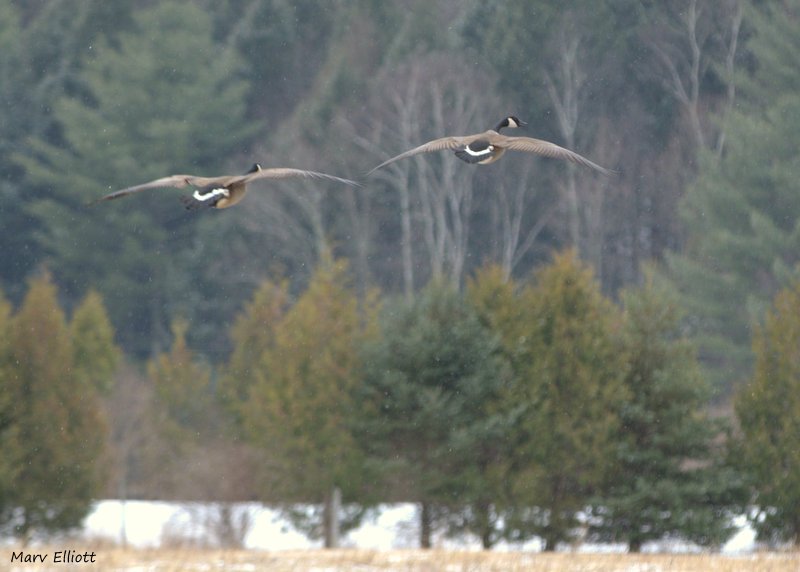
New records were set for Great Blue Heron with a sighting of 4 birds, Canada Geese that tallied 1,444 birds and Song Sparrow that came in with 12 individuals.  The larger than normal number of Canada Geese resulted from unusually large numbers that happened to be moving south on count day.

It was gratifying to welcome several new observers to the count and to the traditional and enjoyable countdown pot luck supper that concluded the day.

Our Position on BJ's Development in Rutland Town

The following is an open letter to the Editor of the Rutland Daily Herald:

The Rutland County Audubon Society (“Audubon”) needs to clarify recent misinformation in this newspaper about the proposed BJ’s project.

  • Audubon supports development that does not harm the environment and makes responsible use of natural and manmade resources.
  • As background, Audubon controls protected wetlands containing an important water source next to the proposed BJ’s that would be built by developer Saxon Partners.

Audubon controls an additional parcel of land that is unprotected from development, but which helps it shield the wetlands and fulfill its responsibility to protect them. Audubon must cooperate with the required Act 250 environmental permit if any developer wants to build there.

Eight years ago, another developer planned to build on the site proposed for BJ’s and requested Audubon’s cooperation to use its unprotected land.

Audubon was advised to cooperate in exchange for a donation of $40,000 for conservation activities because it lacked money for legal resources to fight the development.

Consequently, Audubon cooperated and the developer got his Act 250 Permit—but Audubon never received the promised funding. That development was ultimately abandoned.

The land is now being sold to Saxon Partners to construct a BJ’s with a gas station and 60,000 gallons of underground storage near Audubon’s wetlands. Audubon never agreed to cooperate with that substantial change, which still must get permission from the District Environmental Commission #1 to proceed.

Audubon tried, in good faith, to satisfy its mission to protect the environment and its legal responsibility to protect the conserved wetlands, while recognizing legitimate need for jobs, tax revenue, and places to shop. Given the material change of the BJ’s project, Audubon has refused to sign a new agreement to cooperate although asked to do so.

Marv Elliott President, Rutland County Audubon Society Rutland Town

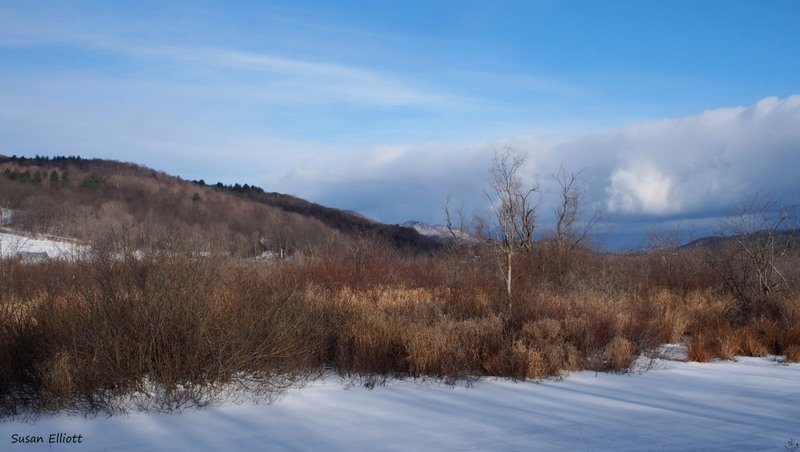
West Rutland MarshThe importance of wetlands cannot be over-emphasized. They absorb flood waters, improve water quality and remove pollutants, and provide habitat for countless species of animals, bird, insects and plants. They also provide a refuge of quiet and peace for people. 

Check out this video (click here) on restoring Vermont's wetlands by the Vermont Natural Resources Conservation Service. RCAS's own Roy Pilcher appears in it. 

west rutland marsh - december monitoring report

The number of participants was almost more than the number of birds at today’s walk around West Rutland Marsh, our 172nd monthly walk. The species count came in at 21, four less than a year ago, but one more than our December average.         

The balmy weather was the highlight of the day and was perhaps the cause of the low count. There are plenty of fruits and seeds available and, of course, there is no snow cover yet.

American Tree Sparrows, along with chickadees, can be found in good numbers near the feeders by the boardwalk.

Two House Finches were seen, but there was no sign of the Purple Finches what have been widely reported around the state this past week. A Red-bellied Woodpecker was heard, a species only being reported at the marsh in the past couple of years.

The large flock of Wild Turkeys, counted today at 29, continues in the fields near the corner of Pleasant Street and Whipple Hollow Road.

The next count is scheduled for Saturday, January 16, at 8 a.m. Perhaps by then we will have more wintry conditions.

Today’s count:

Wild Turkey  29
Red-tailed Hawk  2
Rock Pigeon (Feral Pigeon)  3
Mourning Dove  12
Red-bellied Woodpecker  1
Downy Woodpecker  1
Hairy Woodpecker  2
Pileated Woodpecker  2
Blue Jay  9
American Crow  6
Common Raven  3
Black-capped Chickadee  31
Red-breasted Nuthatch  1
White-breasted Nuthatch  2
European Starling  1
American Tree Sparrow  11
Dark-eyed Junco (Slate-colored)  3
Northern Cardinal  3
House Finch  2
American Goldfinch  31
House Sparrow  3